Introdcution
As decentralized applications (dApps) grow in complexity, the communication layer between clients and blockchain nodes becomes increasingly important. Two communication models often compared are RPC (Remote Procedure Call) and gRPC (Google Remote Procedure Call).
Both frameworks enable applications to communicate with remote systems. However, they behave very differently, especially in blockchain environments where node interactions must be fast, precise, and consistently available.
This article provides a detailed and technical comparison of rpc vs grpc , explains how each approach works, and evaluates which is better suited for blockchain dApp development. You’ll also learn why JSON-RPC remains the dominant interface for blockchains such as Ethereum, BNB Chain, Polygon, Avalanche, and Base — and why decentralized RPC infrastructure (like dRPC) provides major performance advantages.
What Are RPC and gRPC?
RPC — Remote Procedure Call
RPC is a communication model where an application calls a function on a remote server as if it were a local function. In blockchain, JSON-RPC is the default interface used to interact with nodes.
gRPC — Google Remote Procedure Call
gRPC is a high-performance, language-agnostic RPC framework built on Protocol Buffers and HTTP/2. It’s widely used in microservices and backend infrastructure, not in blockchain node APIs.
console.log( 'Code is Poetry' );
How RPC Works in Blockchain Environments
RPC is foundational to Web3. Nearly all EVM-compatible blockchains expose node operations through JSON-RPC , a lightweight, method-based protocol.
Where JSON-RPC Is Used
JSON-RPC is the standard interface for:
-
Ethereum
-
BNB Chain
-
Polygon
-
Avalanche
-
Optimism
-
Arbitrum
-
Base
-
Cronos, and many others
It supports method-centric operations such as:
-
eth_getBalance
-
eth_sendRawTransaction
-
eth_getBlockByNumber
-
eth_call
-
eth_estimateGas
Example JSON-RPC Request
    					{
      "jsonrpc": "2.0",
      "method": "eth_blockNumber",
      "params": [],
      "id": 1
    }
Example JSON-RPC Use in Code
    					const Web3 = require("web3");
    const web3 = new Web3("https://lb.drpc.live/eth");

    const block = await web3.eth.getBlockNumber();
    console.log("Latest block:", block);
RPC’s simplicity, low latency, and native compatibility with node functions make it ideal for dApps.
How gRPC Works in Traditional Systems
gRPC is a modern RPC framework built by Google. It uses:
-
Protocol Buffers (protobufs) for data serialization
-
HTTP/2 for multiplexing and streaming
-
Bi-directional streaming capabilities
-
Strictly defined service contracts
Typical Use Cases
gRPC is commonly used in:
-
Internal microservices
-
High-performance backend communication
-
Real-time systems
-
Cloud-native service meshes (e.g., Istio, Envoy)
Advantages
-
Extremely fast serialization
-
Strongly typed contracts
-
Full-duplex streaming
-
Efficient inter-service communication
Disadvantages for Blockchain
-
Requires protobuf schemas
-
Requires a gRPC server implementation
-
Not natively supported by blockchain nodes
-
Limited tooling in Web3 developer workflows
This is why rpc vs grpc compares two very different paradigms — one native to blockchains, and one native to backend microservices.
RPC vs gRPC: Key Differences
Below is a technical comparison specifically tailored to blockchain.
For more background on how RPC compares to other API architectures, see this overview from Nordic APIs.
FEATURE
JSON-RPC (RPC)
gRPC
Primary use
Blockchain nodes
Macroservices
Transport
HTTP / Websocket
HTTP/2
Serialization
JSON
Protocol buffers
Set up complexity
Minimal
High: requires .proto files + compilation
Speed
Fast
Very fast
Streaming
Supported via websockets
Native
Ease of use
Very easy
Moderate/complex
Web3 library support
Extensive
Nearly none
Best for
dApps, wallets, explorers
Internal backend systems
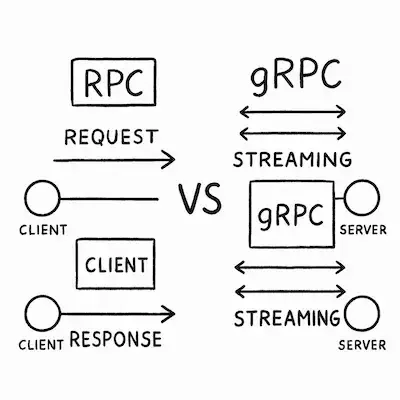
The entire blockchain ecosystem is built on JSON-RPC , not gRPC. This is central to the “rpc vs grpc debate” for dApps.
Why RPC Is Better for Blockchain dApps
Native Compatibility
All blockchain nodes implement JSON-RPC. No blockchain implements gRPC natively.
This makes RPC the only interface compatible with:
-
Web3.js
-
MetaMask
-
WalletConnect
-
Hardhat / Foundry / Remix
-
Indexers
Faster Request–Response Cycle
Although gRPC is technically faster in raw serialization, blockchain calls involve:
-
Network latency
-
Node processing
-
Consensus state reads
In this context, JSON-RPC is faster because:
-
It maps directly to node methods
-
No schema compilation
-
No extra abstraction layers
Easier Debugging
JSON is human-readable. Protobufs are not.
For debugging smart contract interactions, JSON’s clarity matters.
Web3 Tooling
Entire Web3 infrastructure — SDKs, explorers, wallets — depends on JSON-RPC.
gRPC is rarely used outside internal enterprise blockchain tools.
Summary
When evaluating rpc vs grpc for blockchain, RPC is simply the ecosystem standard. It is faster to integrate, easier to maintain, and universally supported.
When gRPC Might Be Useful
Although gRPC is not used to interact with blockchain nodes, it has valid blockchain-related applications:
Off-Chain Microservices
dApp backends often require:
-
User session services
-
Data indexing pipelines
-
High-frequency internal APIs
-
Wallet services
-
Real-time analytics
gRPC excels here because of:
-
Low overhead
-
Contract clarity
-
Multiplexed communication
Bridges and Oracles
Some cross-chain systems use gRPC internally to communicate between components.
Layer-2 Sequencer Internals
Some rollups use gRPC between sequencer components, but they still expose JSON-RPC externally.
Why gRPC Is Less Practical for Blockchain Node Calls
-
No blockchain node runs a gRPC interface
-
No Web3 client supports gRPC
-
No wallet is built on top of gRPC
-
No ecosystem standard schema for blockchain RPC calls
Thus, gRPC remains an internal-only backend protocol , not a blockchain access layer.
A deeper analysis of RPC and gRPC in Web3 contexts is explored here.
High-Speed RPC Infrastructure for Blockchain Developers
To get the best performance for JSON-RPC calls, developers depend heavily on reliable RPC providers.
Why RPC Speed Matters in dApps
-
Contract calls occur every block
-
UIs must update instantly
-
Wallets need real-time feedback
-
Events and logs must sync efficiently
-
Backend processors handle thousands of requests per second
How Decentralized RPC Providers Improve Performance
dRPC uses a globally distributed,decentralized RPC provider network, giving developers:
-
Faster response times
-
Automatic failover between node operators
-
Multi-chain support from a single endpoint
-
Higher uptime than centralized RPC systems
-
Consistent and predictable latency
Developers can easily connect to any chain via:
Explore decentralized RPC infrastructure at dRPC
Browse multi-chain RPC endpoints on dRPC Chainlist
FAQs
What is the difference between RPC and gRPC?
RPC is a method-based communication model used in blockchain, while gRPC is a high-performance framework used in microservices. Blockchains use JSON-RPC, not gRPC.
Is gRPC faster than JSON-RPC?
In raw serialization speed, yes. But blockchain calls involve node processing, making JSON-RPC faster and simpler for dApp development.
Why do blockchains use JSON-RPC?
JSON-RPC is lightweight, compatible with Web3 tools, human-readable, and maps directly to blockchain node methods.
Can I use gRPC for blockchain dApps?
Not for node communication. No blockchain nodes expose gRPC interfaces. gRPC is only useful for off-chain internal services.
What is the best RPC infrastructure for developers?
Decentralized RPC networks like dRPC offer speed, uptime, and reliability across multiple chains.
Take-Away
Choosing between rpc vs grpc requires understanding each protocol’s purpose. gRPC is excellent for high-performance microservices and off-chain system communication, but it is not designed for interacting directly with blockchain nodes.
JSON-RPC, on the other hand, is the native communication layer for nearly every blockchain network. It is simple, efficient, widely supported, and deeply integrated into the Web3 ecosystem.
Combining JSON-RPC with decentralized providers like dRPC ensures high-speed, low-latency, and globally reliable access to blockchain data — essential characteristics for production dApps.