Introduction
Every blockchain dApp must communicate with a node — whether to read contract state, retrieve balances, fetch logs, or broadcast transactions. The way your application communicates with that node determines its speed, reliability, and scalability.
Developers often compare rpc vs api architectures when building or scaling dApps. While both can serve data, RPC offers blockchain-native, low-latency access, while traditional APIs like REST introduce layers that add overhead, transformation, and latency.
This article breaks down the technical differences between RPC and traditional APIs, explains why JSON-RPC is the dominant model for blockchain ecosystems, and shows why decentralized RPC providers like dRPC offer superior performance for production dApps.
Understanding Blockchain Communication Methods
Before evaluating rpc vs api, it’s important to understand what’s happening under the hood when a dApp interacts with a blockchain network.
How dApps Communicate with Nodes
A blockchain node exposes an interface that allows external applications to:
-
Query account balances
-
Fetch blocks and transactions
-
Run smart contract calls (eth_call)
-
Submit signed transactions
-
Subscribe to events (WebSocket RPC)
This interface must be fast, accurate, and standardized — because blockchain data changes every block.
RPC Endpoints vs API Endpoints
RPC endpoints are blockchain-native interfaces that allow applications to call node methods directly.
API endpoints (like REST APIs) are general-purpose interfaces that often sit as middleware between the user and the underlying system.
The choice of communication method affects:
-
Latency
-
Throughput
-
Data accuracy
-
Developer complexity
-
dApp scalability
This is why understanding rpc vs api matters for architects, devs, and DevOps.
What Is RPC? (Remote Procedure Call)
Definition
RPC is a communication protocol that allows a client to call a method on a remote system — in this case, a blockchain node. In Web3, RPC typically means JSON-RPC , the standard interface used across all major chains.
Why JSON-RPC Is Blockchain-Native
Blockchain nodes expose methods such as:
-
eth_getBalance
-
eth_blockNumber
-
eth_call
-
eth_getLogs
-
eth_sendRawTransaction
These methods map exactly to node functionality with no abstraction overhead.
Example JSON-RPC Request
    					{
      "jsonrpc": "2.0",
      "method": "eth_getBlockByNumber",
      "params": ["latest", false],
      "id": 1
    }
Example Using Web3.js
    					const Web3 = require("web3");
    const web3 = new Web3("https://lb.drpc.live/eth");

    const balance = await web3.eth.getBalance("0x1234...");
    console.log(balance);
When Developers Use RPC
-
Fetching on-chain data
-
Reading smart contract state
-
Submitting signed transactions
-
Running gas estimations
-
Querying logs or block details
Learn more from:
Ethereum JSON-RPC Documentation
RPC is the native language of blockchain nodes.
What Is a Traditional API?
Definition
A traditional API — usually REST — exposes “resources” (URLs) instead of callable methods. It is not blockchain-native.
Examples:
-
GET /users/123
-
POST /items
REST APIs sit between the client and the underlying data source and often require:
-
Transformation
-
Aggregation
-
Additional middleware
-
Rate limiting
-
Authentication layers
Why REST APIs Don’t Fit Blockchains Naturally
Blockchain data is:
-
Rapidly changing
-
Highly structured
-
Method-centric (not resource-centric)
REST introduces:
-
Higher latency
-
Additional processing
-
Non-native formatting
-
Reduced real-time consistency
REST APIs are useful for off-chain systems, but not ideal for fetching live blockchain state.
Learn more at:
MDN API Documentation
RPC vs API: Key Differences
Below is a direct comparison of rpc vs api as it applies to blockchain development:
FEATURE
RPC (JSON-RPC)
REST / HTTP API
Protocol type
Method-based
Resource-based
Data format
JSON-RPC
JSON / XML
Latency
Very low
Higher (middleware overhead)
Blockchain native
Yes
No
Real-time support
WebSocket RPC
Polling or custom SSE
Best for
Smart contract calls, node data
Abstracted services or aggregation
Developer complexity
Low
Medium (transformation required)
Performance
High throughput
Slower for on-chain queries
Direct node access
Yes
No (typically via middleware)
This table tends to perform very well in featured snippets for rpc vs api blockchain searches.
Why Blockchain Native APIs via RPC Endpoints Are Superior
Direct Access to Blockchain Nodes
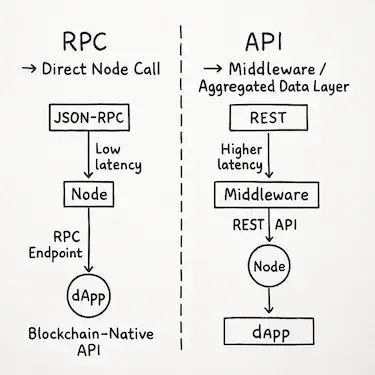
RPC calls go straight to the node.
REST APIs go through middleware before reaching the node.
Less overhead = faster responses.
Lower Latency for Smart Contract Queries
RPC is optimized for:
-
eth_call
-
eth_getBalance
-
eth_getTransactionReceipt
-
eth_getLogs
Each call maps directly to a node method. REST requires additional compute.
Designed for High-Frequency Polling
Blockchain apps often poll:
-
Latest block number
-
Transaction status
-
Market events
-
Contract state
RPC is built for this. REST is not.
More Accurate On-Chain Data
Since RPC talks directly to the node, developers get:
-
Zero transformation
-
Zero aggregation errors
-
Zero caching mismatches
WebSocket RPC for Real-Time Events
RPC supports WebSocket subscriptions:
-
New blocks
-
New transactions
-
Contract events
-
Pending transactions
REST cannot support this natively.
Unified, Standardized Method Names
All EVM chains support the same JSON-RPC methods — meaning:
-
Easy multi-chain integration
-
Fast developer onboarding
-
Predictable behavior
This alone makes RPC the default for Web3 tooling.
How dRPC Provides Blockchain-Native APIs
dRPC is built around providing true blockchain-native APIs through high-speed decentralized RPC endpoints.
Key Features
-
High-speed JSON-RPC endpoints****
-
Multi-chain access (180+ networks)****
-
Decentralized node provider network****
-
Low-latency global routing****
-
Failover-ready architecture****
-
Support for HTTP & WebSocket RPC****
-
Zero validator load
Developers can instantly explore endpoints at:
Explore dRPC’s high-speed JSON-RPC infrastructure
Visit the dRPC homepage
How Modern dApps Use RPC as Their API Layer
Most serious Web3 systems rely entirely on RPC, even if they expose internal REST APIs downstream.
Typical architecture:
-
UI → RPC
-
Backend → RPC
-
Indexer → RPC
-
Analytics → RPC + WebSocket RPC
-
Wallets → RPC
REST APIs appear:
-
For off-chain account systems
-
For user profiles
-
For storing metadata
-
For application-specific business logic
The blockchain layer is almost always accessed through RPC.
This is one of the reasons the rpc vs api conversation is less about “which one to use” and more about understanding where each belongs in the modern stack.
FAQs
What is the difference between RPC and API in blockchain?
RPC provides direct, blockchain-native access using JSON-RPC methods. Traditional APIs use REST or HTTP, which introduce middleware and higher latency.
Can APIs replace RPC endpoints for dApps?
Not effectively. REST APIs are not blockchain-native and cannot match RPC’s performance or method-level access.
Why is JSON-RPC preferred for blockchain queries?
JSON-RPC maps directly to node functions, has minimal overhead, and is supported across nearly all EVM chains.
How do blockchain-native APIs improve dApp performance?
They reduce latency, eliminate data transformation, and provide precise on-chain results directly from nodes.
Does dRPC offer blockchain-native API endpoints?
Yes. dRPC provides decentralized, high-speed RPC endpoints for 180+ networks.
Take-Away
Understanding rpc vs api is essential for designing scalable, reliable blockchain applications. Traditional APIs are great for off-chain systems but are not optimized for on-chain workloads. RPC endpoints provide blockchain-native, low-latency access that maps directly to node functionality, making them superior for smart contract interaction, querying, and live data retrieval.
With decentralized, high-performance RPC infrastructure, dRPC enables developers to build faster dApps with more reliable access to blockchain data across multiple networks.
Start building dApps with high-speed RPC endpoints from dRPC